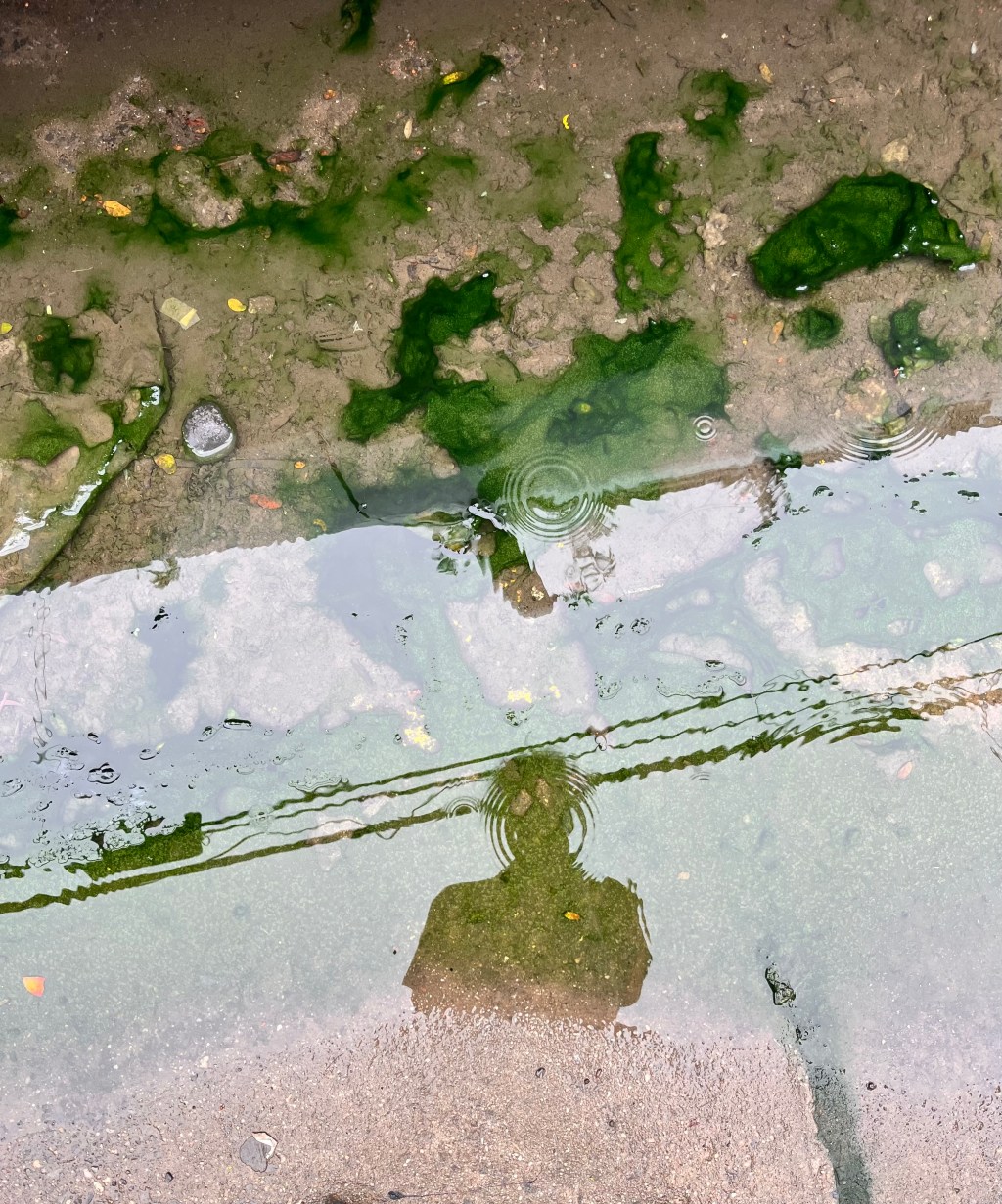
I had the sense going into 2024 that I would be need to be patient and stay focused. I had experienced a strong enough taste of Yoga Nidra from the previous months of practice that began last Fall, to know that continuing a daily practice was going to change things. I knew that the friction between inner and outer world would present challenges.
What I didn’t expect, was that punctuated across stretches of time when it seemed almost “nothing” had happened— delays and disappointments, boredom, confusion, frustration, and a whole lot of just lying in bed recovering, trying to pass the time— were huge moments of catharsis that created change that lasted. Ways of thinking and feeling that just…completely stopped. Enduring qualities of contentment and clarity that stayed in the foreground, emotions roiling in the background like a stormy sea viewed from a window while I was cozy and dry.
No stranger to self-induced altered states, which is really what self-hypnosis (and sometimes Reiki) allows us to do, I was familiar with cathartic insight. And I’ve had a few experiences with psychedelics that did this too. Insights can definitely last, with their associated feelings more manageable as a result. I mean, this is what I teach! So…maybe it shouldn’t have been surprising. But I must confess that I generally have believed that those experiences tend to move in cycles, tied together by the act of integration. I had not seriously considered the role of preparation, and how that might allow catharsis pull something from the root. I learned that gentle, consistent, loving, and patient preparation could allow for a much deeper experience of change.
Preparation is, by nature, a bit boring. Even if it is devotional (and sometimes pleasurable as its own action), to prepare is to engage in a practice that leads us to the place where the action happens. If not an act of faith, it is at least an act of hope. Doing something that in itself will not give you the result you seek, but will instead naturally reveal the path forward, requires believing that these keys exist within you already. (Dorothy and her slippers)
Something that stood out to me in my early reading as I learned more about Yoga Nidra and Tantra, was that the techniques, the structure, and flow of the practices were not the thing itself— they were the preparation for the state of Yoga Nidra, for Samadhi, perhaps even for Turiya, bliss. This echoed much of my experience with Reiki, that while we might continue to practice the techniques and rituals, they ultimately lead to a state of connection and flow that required us to let go of the “techniques.” At some point the energy itself becomes the teacher, and if you have prepared sufficiently you’ll know when to loosen the grip that constrains possibility.
In conversation with a friend I was trying to explain exactly what had turned my mind upside down and inside out. “Is this what Yoga Nidra does? Or just for you?” she asked.
I almost laughed— it was a good question.
Wtf happened? Is it replicable? It is valid? (… Is it interesting?)
I mean in short, yeah, I think if you put in the time the practices will lead you there. They work for everyone.
There isn’t really a shortcut for any approach to healing. In my case I spent upwards of 20 years “preparing” for some of the shifts I’ve experienced recently that I never thought were possible. I couldn’t really dream that big, maybe they were possible for some but I was kind of at peace with the idea that I might not get there. “Here” was good enough, and I meant it.
I went through several cycles of being amazed at what was possible— an incredible inverse of the common experience people have with trauma recovery, “but wait, there’s more!”
I wrote a whole different version of this essay that was less vulnerable, in part because I’m sensitive to the fact that maybe some of this sounds unbelievable— as in, not real. I wanted to use my own experience as an example, knowing that it looks different for everyone. I don’t claim that my experience is the norm or an exact blueprint to follow. But sometimes preparation is considering the possibilities that could be available, flipping through a field guide in advance so that when you encounter something unfamiliar you can say “hmm, I wonder if this is _____?”
I wanted to try working with a practice I learned in a recorded talk with Swami Premajyoti back in January, that felt a bit too advanced for me at the time but nonetheless set the stage for my Sadhana. As I listened again, some of it I remembered and some parts landed in a new way. The part that really hooked me the first time was something like, “once you harness the power of the mind, you need never be concerned by any thought ever again. Because you can simply let it go.” It was a compelling idea.
Herself a psychotherapist before renunciating, she also explained that Yoga Nidra is well-suited for trauma and can be practiced by anyone. What my mind had forgotten, but I must have heard clearly, was that in learning to move between states of consciousness, and experiencing greater distance between the mind, emotions, memories and beliefs, and awareness itself, one may encounter fragments of trauma and painful emotions.
This echoed my prior experience of encountering all the inner obstacles to rest, when you practice deep relaxation.
Swami Premajyoti went on to say that if the preparation has been sufficient (in this case, the withdrawal of the senses into the body), the associated emotions can be tolerated and examined in ways that are not possible in other states of consciousness. It can be practiced in small increments that increase over time.
The ability to be less consumed or immersed in the emotional resonance allows us to linger, in ways that would otherwise be too painful, long enough for the mind and body to heal itself. She emphasized that it wasn’t necessary to “work with this” so much as allow the healing to occur.
This knowledge in itself became a form of preparation that meant that I didn’t feel like I was “failing at meditation” when it happened to me. Along with a suggestion from my friend and fellow mind-space explorer, to try to soften and stay with the sensation, I gradually built tolerance and a new relationship to those familiar feelings. I have come to befriend this phenomena of unearthing, and was so moved by some of these encounters that I wrote an essay about it, The Quiet.
It seems almost taboo as a therapist to suggest that some healing just happens on its own. Because that’s only a partial truth. Getting your mind of the way, while still observing and witnessing, is no easy feat. Whether you call it grace, something bigger than yourself, nature, energy, hope, willingness, luck, or God, you can’t make it happen by sheer will. Or maybe it’s like a lucid dream, once you realize what’s happening it’s hard to resist “getting involved” and waking yourself up.
There is power in witnessing. This is perhaps a crucial role of the mind in catharsis: to direct attention and energy to the places that need healing, while not trying to dictate how it occurs. I suppose we would say that wisdom is the driving force, but it begs the question— how do we experience wisdom without thought?
Ericksonian hypnosis, another favorite modality of mine, bears some strong similarity to the techniques of Yoga Nidra. The cynic in me does wonder if these ancient practices were an influence, and yet it also seems appropriate that Milton Erickson might have learned them in his experience losing the use of his legs as a young person, as the story goes. Because there are many ways to encounter true wisdom, and there is a reason why many of the wisdom practices are similar in form. Eduardo Duran refers to Erickson as a sort of shaman in his novel The Buddha in Redface, and I think there’s some truth to that.
I suspect that the reason why this style of hypnosis is not so popular in the mental health field, and often described as mysterious and lacking empirical validity, is because it relies heavily on the belief that that client has all the information needed to heal themselves, and that the practitioner’s role is that of an intuitive other who joins and supports them in the trance state. In fact the practitioner must hold themselves in a light trance to do it. In fact some of my most powerful experiences of hypnosis have occurred while guiding myself. And we all can enter trances spontaneously, in everyday moments like taking a walk or watching TV.
This summer I got really into the Olympics. Specifically I was watching the surfing competitions. Hours and hours of surfing heats, which is mostly watching the waves, and listening to commentators waxing poetic about the spiritual side of surfing and the connection with the ocean. These were punctuated by exhilarating moments of something akin to magic, people flying across the surface of the water on sculptures made of fiberglass.
And while transfixed by a particular display, I found myself in a representation of the levels of consciousness that obscure the mindspace that leads beyond the self— the Chidakasha or Chittakash.
In this metaphor the ocean forms the layer of the unconscious mind, and its waves approximate spontaneous thought. The ocean is a vast space, not exactly infinite but so large it is beyond our ability to see it all at once. The environment helps it form waves across the surface— sometimes big, sometimes small, sometimes in sets, organized and unorganized— which materialize and dissipate continuously. This is simply the nature of the ocean, to wave.
Then we have the surfers, who are floating on the surface, ready to reach out and “grab” the waves that are appealing. Such waves materialize and flow through our awareness. Sometimes we grab hold and explore them, let them carry us from one place to another. And other times we begin with a spontaneous thought and then begin to create totally new thoughts out of nothing. It is often hard to distinguish between the two because it happens so quickly. To harness or create thoughts is a powerful skill, but often we do so without awareness, driven by our fears and anxieties rather than our creative potential.
Beyond that we have the commentators. They create a constant narration, analyzing the waves and the surfers, going on tangents about where (this surfer) came from, how well they know this wave, and remember that competition at Pipeline in Hawaii in 2019?Often times we find ourselves a bit stuck in this dynamic in meditation. We’ve pulled back from the thoughts themselves, we’ve learned how to be a bit less involved, but our mind is still telling the story of the thought process— the narrator masquerading as the voice of awareness.
But if we pull back another later we arrive at the TV screen, the mind space. All the layers are happening simultaneously across the screen, and focus can shift from one to another freely. Or we can take them all in.
And then who is watching all of this? There is the viewer (you), somewhat beyond the physically limited screen, observing it all while also knowing that the screen is both a representation of reality and not their actual reality. In the viewer we find an approximation of the witness consciousness, the true self, or the core self. And of course, the awareness that anyone watching the space is a viewer, having both the same experience and one that is unique to them.
Am I making sense?
From this spacious distance, we can watch without becoming involved. And the same premise can apply to the physical body, the emotional body, and the energetic body. Knowing where you are, how to zoom in and pull back, is a form of preparation that allows us to enter non-ordinary consciousness at will, and get out of the way when something extraordinary is about to happen. The space of the mind and body becomes more flexible, the “channel” can be changed, our awareness can shift, and the limited nature of the mind is revealed. Attached though we might be to the details and changing landscape, from a distance we have access to so much freedom of movement.
I had a dream a few nights before finishing this essay. In my dreamscape the energy of the mind could be temporarily separated from the energy of the body and could travel freely through time. The fields were never completely detached, but operating independently. Yet even though the mind traveled, there wasn’t a whole lot of content to it. Trying to “see” certain scenes from the future or past was such an obvious limitation to what could be learned through simply experiencing it. The feeling was clear and didn’t need to be articulated, and bypassing the mind meant that it was integrated with little effort. It works better in dreamspace than it does while I’m washing the dishes…
Some prompts for reflection:
How do you conceptualize your mind, wisdom, and awareness?
What layers of awareness are most active in your internal world? Do you create thoughts out of nothing?
When you experience glimmers from the past in the form of memories or emotions, how do you work with them in the present?
How do concerns and hopes for the future take the form of creating thoughts? Is it easier to create or release those thoughts?
What lies just beyond what you can imagine is possible?
 Inward Vision