You might think you really know yourself, and what you’re capable of, until you endeavor to move through a period of time without a well-formed “plan.” It turns out many attributes that I thought were character might’ve been well-honed methods pretending that I can control the outcome of my life.
Boredom becomes a sticky, viscous material when you’re trying to lose yourself. A quiet question drifts below the surface, so faint that it’s almost indecipherable. You have to get very close to hear it— a question that feels like longing but reveals itself to have the keys to contentment, if you can just slow down enough to notice that everything you’re looking for is already here.
There’s a certain refrain about not “keeping yourself small” and encouragement to take risks by daring to take up more space, maybe you know what I mean. I have echoed such sentiments, and often taking up more space is an act of rewriting old stories and building self-trust. Sometimes we need to remember that we can take bold, decisive action. But sometimes beneath that lies an insidious belief— that to be valuable and have purpose means you need to be on an ever widening quest. That you’re supposed to “be bigger” and that not seeking to grow as much and as fast as possible means you are holding yourself back. That you’re not where you’re supposed to be and you need to work harder to get there.
And yet, in a world with limited resources and attention, we cannot all be constantly expanding. Bigger is not always better, more is not always more. Moving quickly is easier to achieve by relying on patterns and integrated knowledge, to essentially reform and reorganize information, rather than create new thoughts (or pare back to the essentials).
How does one harness the power of an active and generative mind, and apply it towards a protracted period of seeming dormancy? How do we experience ideas when the landscape is ever changing? Can we allow ourselves to be lost until something changes within us, until we encounter something that feels genuinely new?
When I visit a new place one of my favorite things to do is “get lost” in a city or neighborhood. I might do a little research to narrow down the area, but otherwise I wander around following my interest. I observe my environment as if in technicolor, and try to avoid taking out my phone or a map. Even though I know NYC pretty well after 20+ years I try to do that here from time to time, especially when visiting a neighborhood I have’t been to in a while. I allow the experience to be shaped moment by moment.
Why is it so difficult to explore the inner landscape this way, to allow the movement of thoughts and emotions to be a beckoning call of curiosity, instead of a point of analysis or invitation to detach? How does one allow the natural movement of the mind, observing carefully without attending to it or pushing it away?
In Radical Friendship a question that struck me was how we act as a friend to ourselves. I began to wonder if in my attempt to “manage,” “heal,” or “let go” of certain anxieties I was behaving like a friend who couldn’t really listen, who rushed towards a solution and ended the dialogue prematurely. In the service of not reenforcing harmful stories, I had overcorrected and developed a habit of abandoning myself in those moments of need. I started noticing how so many of those I know and work with struggle with similar behaviors, this urge to push yourself so hard towards health that you become too impatient to listen and allow for what was being felt.
Last November I started taking myself on walks, imagining that I was a good friend listening to that part of me venting and sharing for as long as it took. I would ask myself attentive, open-ended questions and be willing to hear the old stories. Often something would be revealed as a result of playing the tape and continuing to dialogue.
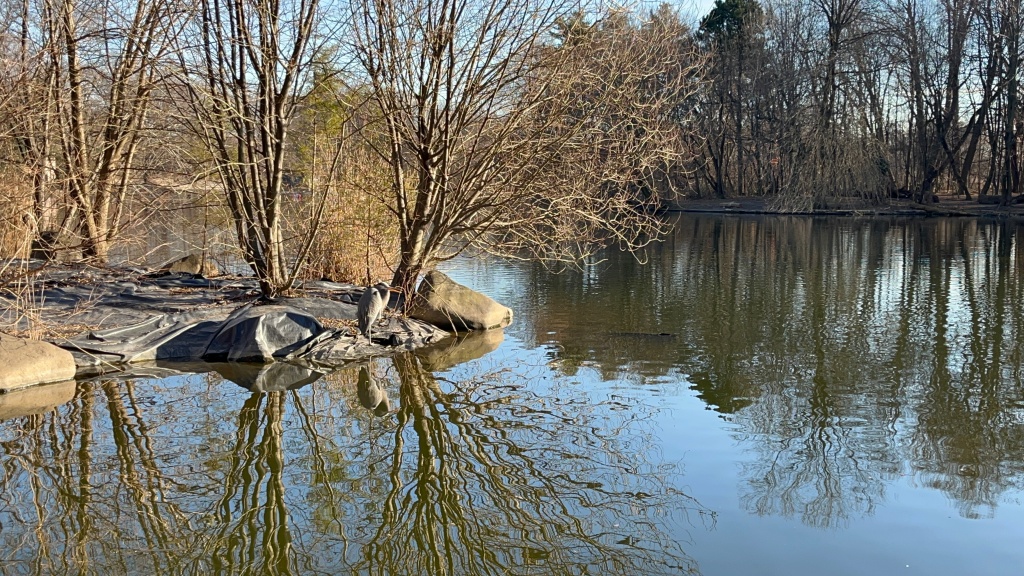
Sometimes we think we’re listening to an old story when we’re really just hearing the prologue. Other times we think we’re encountering a new idea when really we just hearing the remix. In both cases we benefit from taking the time to listen all the way through, and pausing before taking an action. When I think about those conversations with abandoned selves, I see the shapes of winter trees, and hear the sound of crunching leaves. The sparkle of water on the lake fills the silences much like it feels to look deeply in a beloved’s eyes.
When did the skill of avoiding stagnancy become a fear of slowing down? Planning can become its own escape, a more “sophisticated” form of future tripping. While plans are perhaps a healthy way to manage anxieties about the future, and a good way to make progress towards goals, they also box you in and reenforce the idea that you haven’t yet arrived at that place you’re supposed to be.
I am an excellent planner. I’ve been served well by the execution of elaborate plans, and it’s a good skill to have. But a plan is still an idea, and ultimately we only have control over our actions. If you’ve have had the experience of your life being turned upside down my external circumstances, your beautiful plans interrupted or disintegrated in a single act, then you know what I mean. We often view these moments as tragedies, and sometimes they are. But sometimes they present opportunities to change course in radical ways. What happens when you choose to allow this, by loosening your belief that you know where you’re supposed to be?
I was struck by this passage in Getting Lost, where Rebecca Solnit writes,
“Lost really has two disparate meanings. Losing things is the familiar falling away, getting lost is about the unfamiliar appearing. There are objects and people that disappear from your sight or knowledge or possession; you lose a bracelet, a friend, the key. You still know where you are. Everything is familiar except that there is one item less, one missing element. Or you get lost, in which case the world has become larger than your knowledge of it. Either way, there is a loss of control. Imagine yourself streaming through time, shedding gloves, umbrellas, wrenches, books, friends, homes, names. This is what the view looks like if you take a rear-facing seat on the train. Looking forward you constantly acquire moments of arrival, moments of realization, moments of discovery. The wind blows your hair back and you are greeted by what you have never seen before. The material falls away in onrushing experience. It peels off like skin from a molting snake. Of course to forget the past is to lose the sense of loss that is also memory of an absent richness and a set of clues to navigate the present by; the art is not one of forgetting but letting go. And when everything else is gone you can be rich in loss. “
Some prompts for reflection:
What are your associations with being lost? What are some metaphorical or real life examples of being lost in your own history?
How much time and effort do you spend planning, do you feel it’s too much, too little, or in balance?
When has a well-formed plan helped you achieve a dream or goal that didn’t seem possible?
When has an interruption to a plan allowed you to change course? Are there examples of interruptions that have created lasting wounds for you OR positive changes?
What could be gained by allowing yourself to feel lost, or admitting when you feel lost?
Are there times that you have felt lost, when perhaps you were not?
What does it mean to be “rich with Loss?”
 Inward Vision